
It is essential to understand how these rules apply to your estate if you own property or other assets in Spain, have beneficiaries residing there, or are considered a tax resident.
Spanish succession law
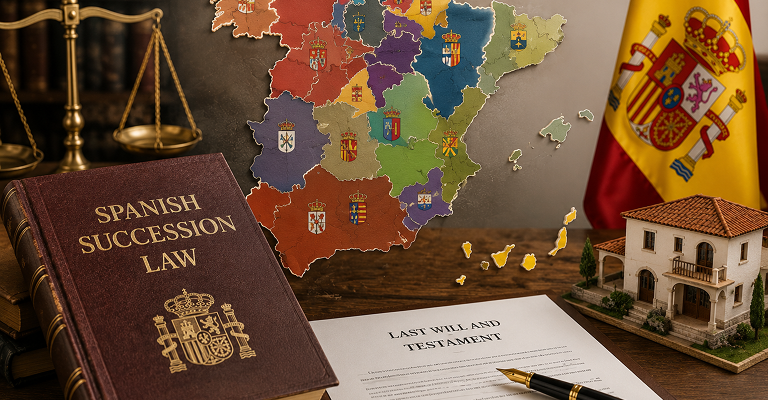
Spain's succession system combines national legislation with regional rules introduced by its 17 Autonomous Communities. As a result, inheritance tax reliefs and allowances can vary considerably depending on where the deceased or beneficiary lives and where the assets are located.
In recent years, many regions have introduced generous tax reductions for close family members, significantly reducing the inheritance tax burden for spouses, children and grandchildren.
These reliefs are not universal; distant relatives or unrelated beneficiaries may still encounter significant inheritance tax liabilities.
Forced heirship
Spanish civil law traditionally follows the principle of forced heirship, under which a significant proportion of an estate is reserved for certain close family members, particularly children.
For many British nationals living in Spain, the position has become more flexible following the introduction of the EU Succession Regulation (commonly known as Brussels IV). In many cases, UK nationals can elect for the succession law of their nationality to govern the distribution of their estate rather than Spanish succession law.
It is important to understand that this election affects who inherits your assets, not where inheritance tax is payable. Spanish inheritance tax rules may still apply.
When drafting a will or reviewing your estate plan, obtaining professional advice is crucial to ensure your wishes are honoured, and your legacy is protected.
Who pays Spanish inheritance tax?
Unlike the UK, where inheritance tax is generally charged on the estate, Spanish Inheritance and Gift Tax is paid by each beneficiary.
Beneficiaries are divided into four groups:
Many Autonomous Communities now extend favourable treatment to registered civil partners and, in some cases, unmarried partners.
Regional differences

Inheritance tax is one of the most regionalised taxes in Spain. While the State sets the basic framework, each Autonomous Community can introduce its own allowances, reductions and tax credits.
Some examples include:
Andalucía
Close family members generally benefit from substantial tax reductions, with generous reliefs applying to inheritances and lifetime gifts. More distant relatives receive significantly lower allowances.
Balearic Islands
Spouses, children and parents currently benefit from very generous reductions, with lower—but still meaningful—reliefs available for certain other family members.
Canary Islands
The Canary Islands offer some of the most generous inheritance tax reductions in Spain, with close family members often paying little or no inheritance tax.
Murcia
Murcia was one of the first regions to introduce a 99% reduction for close family members and continues to offer favourable treatment for spouses and descendants.
As regional legislation changes regularly, it is important to obtain up-to-date advice before making decisions.
Property considerations
Before regional tax reductions were introduced, families often faced difficult decisions following the death of a property owner. Beneficiaries could inherit a share of a property but still be required to pay inheritance tax, even if the property could not immediately be sold.
Today's more generous regional allowances have reduced this problem for many families. However, complications can still arise where several beneficiaries inherit jointly or where beneficiaries fall outside the closest family categories.
UK nationals living in Spain
British nationals should remember that both UK and Spanish tax rules may affect their estate.
Factors that need to be considered include:
- where you are tax resident;
- where your assets are situated;
- whether UK inheritance tax continues to apply to your worldwide estate;
- whether Spanish inheritance tax applies to Spanish assets or beneficiaries;
- how your will interacts with both UK and Spanish succession law.
Cross-border estate planning can help avoid unnecessary taxation, delays and disputes between beneficiaries.
Planning ahead

For expatriates with assets in more than one country, succession planning should form part of a wider financial plan.
Appropriate investment structures may simplify the transfer of assets, provide tax-efficient growth and make it easier to nominate beneficiaries. For example, a Spanish-compliant investment bond can, in appropriate circumstances, offer tax-efficient investment treatment and facilitate the payment of proceeds to nominated beneficiaries without many of the administrative delays associated with other investments.
The most appropriate solution will depend on your country of residence, the location of your assets and your family's circumstances.
Case Study – Why Early Succession Planning Matters
John and Margaret retire to Spain
John (72) and Margaret (69) retired from Surrey to the Costa del Sol ten years ago. They own a villa in Andalucía worth €850,000, have savings and investments of €750,000, and receive income from their UK pensions.
They have two adult children living in the UK and assumed that their English wills would automatically determine who inherited their estate.
During a financial review, they discovered several significant issues:
- Their Spanish property could be subject to Spanish succession rules and inheritance tax.
- Their UK and Spanish wills needed to work together to avoid unnecessary delays and conflicting instructions.
- Their children would each become responsible for any Spanish inheritance tax due on their share of the estate.
- Certain investment arrangements could lead to lengthy probate procedures before beneficiaries received their inheritance.
Following professional advice, John and Margaret reviewed both their UK and Spanish wills and ensured they complemented one another. They also restructured part of their investment portfolio into a Spanish-compliant investment bond, allowing them to nominate beneficiaries directly and simplify the transfer of assets on death.
As residents of Andalucía, they were also able to benefit from the region's generous inheritance tax reliefs available to close family members.
The outcome
When John later passed away, Margaret was able to deal with his affairs far more efficiently than expected. Their investment bond was transferred quickly to the nominated beneficiaries, while their succession arrangements reflected their wishes and reduced unnecessary administrative delays.
Although legal and tax formalities still had to be completed, their family avoided many of the complications that can arise when cross-border estates have not been properly planned.
Key lesson: Good succession planning is not about avoiding tax at all costs. It is about ensuring your assets pass to the people you choose, in the most efficient manner possible, while making full use of the reliefs available under both UK and Spanish law.
Conclusion
Spanish inheritance and succession planning is considerably more favourable today than many expatriates realise. Nevertheless, the interaction between Spanish regional law, UK tax legislation and cross-border succession rules means that careful planning remains essential.
If you have assets in Spain or plan to retire there, reviewing your wills and investment structures in advance can save your family time, money, and stress.
It is necessary to seek advice from an experienced cross-border financial planner and a qualified legal professional to make informed decisions.

About Des Cooney
He has worked in the financial services industry for 30 years as a retirement and wealth management specialist.