

Managing your investments after moving abroad presents a mix of challenges and opportunities.
Financial products that were once tax-efficient are often not treated in the same way in the new country of residence. In fact, you will be dealing with a completely new tax system altogether. Understanding how everything works not only helps avoid unexpected pitfalls but also enables expats to take advantage of allowances and tax-friendly investment products.
Although the general principles of investing remain the same, how they apply to each individual is always different.
We all have unique financial and lifestyle situations, and our investment planning should be tailored as accurately as possible to reflect this.
Auditing Your Existing Investment Position

The first step when assessing our investment needs is to audit our existing position. What do we hold? How are they taxed? Are we happy with investment performance? Do our investments correctly match our risk tolerance? Are your investments meeting the objectives you originally set out? Can we easily access updated valuations at any time? What about charges? Are we paying too much for the returns and service we receive?
Let’s start with establishing what we have. Most of us hold investments in a variety of vehicles.
We might invest in:
- Fund portfolios
- Pension plans
- Cash accounts
- Specialist products such as ISAs
- National Savings Certificates
- Enterprise Investment Schemes
The more varied the collection of investments, the harder it is to view them in context with each other and correctly assess the overall risk profile. It may therefore be a good time to consider consolidating any that create unnecessary replication.
Either way, the goal should be to be able to view your total investment portfolio as a whole, which will make it easier to establish whether your risk profile is still as relevant as when you first invested.
Access, Transparency, and Charges
Ideally, you will be able to access information online in real time. In these technologically advanced times, product providers who don’t enable online viewing at any time aren’t investing in their clients and almost always, alternative arrangements exist that will improve your customer experience.
Similarly, most online systems quote the exact fees applicable to product structures and underlying funds. Again, even if your investments are viewable online, if charges aren’t quoted, it’s important to ask why.
Understanding Cross-Border Taxation
Next, we need to establish how our investments are taxed in our country of residence and if any are also taxed in our home country. Are you thinking of retiring in France, Spain? Portugal maybe?
Dual Tax Treaties usually ensure we aren’t taxed twice on the same money; however, there are also circumstances where withholding taxes may apply in the source country.
There are numerous scare stories on social media about this subject, but the truth is that double taxation for anyone living in a country with a DTT with the one where the withholding tax applies have nothing to fear. Refunds can be claimed, and in some cases, tax can be offset against local taxation.
Pension plan withholding tax can easily be avoided by applying for a Non-Taxable (NT) payroll code.
Performance Review
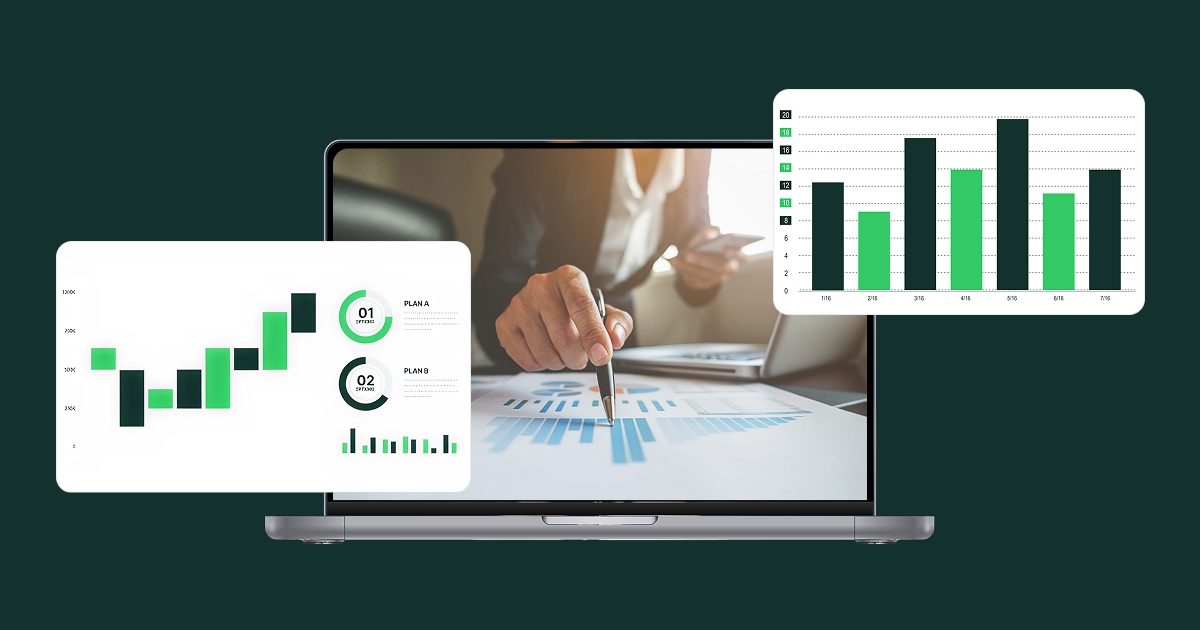
Online wealth management systems will always show the performance of your investment funds. This issue is often linked to fees. All too often, funds that appear to be performing reasonably well are held back by excessive charges.
All regulated funds have to provide investors with details analysis in the form of Fact Sheets and Key Investor Information Documents, which show the annual and year-on-year performance of a fund. Plenty of other information can be found, including charges, fund size, top ten holdings, and how the fund has performed against its benchmark. There are also a number of sites that show performance relative to a fund’s peer group.
Advice Options
The sheer scale of options available these days makes it difficult to be certain that you have chosen the most appropriate funds for your individual situation. We would always recommend using a suitably qualified and regulated investment adviser.
Experience really counts in the pension advice sector, particularly for pension transfers.
If ever you feel you are being sold to, rather than advised, walk away.
Dos and Don’ts When Using an Adviser

Here are a few ‘Dos’ and ‘Don’ts’ when considering investing with the help of an adviser.
Do:
- Do make sure you have all relevant information, including written recommendations that clearly show how a suggested portfolio meets your needs and objectives.
- Do make sure fees and charges are explicitly disclosed, and your adviser holds a MiFID licence.
- Do question recommendations and make sure you are fully aware of expected service levels and what you are paying for. Annual service fees tend to range from 0.30% to 1% per annum.
- Do review your portfolio regularly with your adviser. We seem to have been in a state of constant change over the last few years, with events such as the pandemic, wars, political uncertainty and environmental disasters becoming the norm. Your portfolio should be flexible enough to react to global circumstances quickly and easily.
Don’t:
- Don’t invest based on cold calls. Not all cold calls result in poor investment outcomes, but most poor outcomes originate from cold calls.
- Don’t be pressured into investing in anything that is time-limited. Be very wary of any ‘unmissable investment opportunities’ you see online. Many are posted by companies that aren’t properly regulated, and the sole objective is to relieve you of your hard-earned money. Take your time and do your research.
- Don’t invest in unregulated funds. There is no justification for not using properly regulated funds.
- Don’t invest until you have written confirmation of all details relating to a proposed investment. It’s unfortunately very common for potential investors to go ahead based only on the word of a financial salesperson. Get it in writing and understand your rights and the company’s regulatory accountability before signing on the dotted line.
Advice Process
Here is a quick checklist outlining the advice process for financial planning.
- First meeting to establish your financial position, needs and objectives.
- Written communication confirming the above.
- Specific recommendations in writing following further discussion.
- Work through the recommendations and make sure everything is fully understood.
- When you are happy with the proposal, complete the administration process on time.
- Register for online systems.
- Regular review meetings.
Summary
Investing funds can be a daunting task, however, if we follow a logical process, it can become easier to understand, particularly as our knowledge expands.
Know your investment objectives.
Allocate pots of money to specific life events. Understand where you really sit on the risk scale. Choose your adviser carefully. Don’t be rushed into decisions. Make sure all recommendations are in writing and suitable for you.
Conclusion: Professional Guidance for Expats
Living abroad adds complexity to investment planning, but it also opens the door to more effective structures, better alignment with personal objectives, and improved long-term outcomes when handled correctly. Reviewing existing arrangements, understanding local tax rules, and working with experienced professionals are essential steps in protecting and growing your wealth.
Axis Financial Consultants specialise in advising expatriates on cross-border investment and tax-efficient financial planning. If you are living abroad and want to ensure your investments remain appropriate, transparent, and aligned with your goals, contact us for expert, regulated advice tailored to your circumstances.

About Phil Loughton
He has worked in the financial services industry for 35 years and is an expert in expatriate retirement planning.